Climate change is a complex issue with interconnected causes and far-reaching effects. To avoid getting stuck in a single version of reality, let’s consider various perspectives.
Different Perspectives of Climate Change
The climate is undoubtedly changing… What are the causes and consequences?
Scientists say one thing, while politicians interpret the data differently depending on economics, energy policy, and voters. In public debates, alternative theories are also put forward. Remote viewers, for example, talk about weather modification by military commanders, claiming that they can create storms, increase their intensity, and ultimately want to learn how to control the planet’s weather.
Let’s look at the arguments from each side and try to answer this question.
Social Perspective
If you have seen the film Pressure (2026), which depicts the intense 72 hours before the D-Day invasion in 1944, you know that Allied forces planned to land on June 5 but postponed the operation after meteorologist James Stagg predicted a severe storm that many others failed to anticipate. His forecast identified a brief weather window that ultimately allowed the invasion to proceed on June 6.
Even at that time, the experts’ knowledge and the military’s capabilities demonstrate that controlling weather has long been strategically important and viewed as a potential advantage on the battlefield. Today some remote viewers suggest that besides the Sun entering a more energetic field, the military is also modifying the weather, which is causing climate change.
Actually, remote viewing has an interesting connection to the U.S. military as they originated from U.S. government research programs exploring whether people could obtain information about distant locations or events without physical access during the Cold War. Although those programs eventually ended, many participants continued practicing remote viewing independently and can be found on VEREVIO and similar sites right now.
Scientific Perspective
According to the scientific community, the main driver of modern climate change is also human activity. Every time we burn coal, oil, or natural gas, or clear forests, we add greenhouse gases to the atmosphere. These gases work like an extra layer around the planet, trapping heat and slowly raising global temperatures.
The change may sound small on paper. Since the pre-industrial era, the Earth’s average temperature has increased by just over 1°C. But even this seemingly minor shift has measurable consequences.
Glaciers are shrinking on every continent, the Greenland and Antarctic ice sheets continue to lose mass, and global sea levels have risen by more than 20 centimeters (8 inches) since 1900 as warmer water expands and land ice melts.
The effects are becoming increasingly visible in everyday life. Warmer oceans provide more energy for storms, leading to heavier rainfall and stronger hurricanes. Heatwaves occur more often and last longer than they used to, putting additional pressure on people, wildlife, agriculture, and infrastructure. For scientists, climate change is therefore not a prediction about the distant future but an ongoing process that is already reshaping the planet.
Political Perspective
The political perspective on climate change is highly polarized. For example, according to a recent article on CNN, the US government has declared war on the very idea of climate change. They cite Energy Secretary Chris Wright, who made millions in the fracking industry and commissioned the report.
“Climate change is real, and it deserves attention,” he wrote. “But it is not the greatest threat facing humanity. That distinction belongs to global energy poverty.”
Scientists across multiple disciplines are sounding the alarm. They say the administration’s attempts could destroy scientific research in the US. These competing priorities explain why climate policy often remains one of the most debated issues in modern politics.
Understanding the Climate Change Impacts
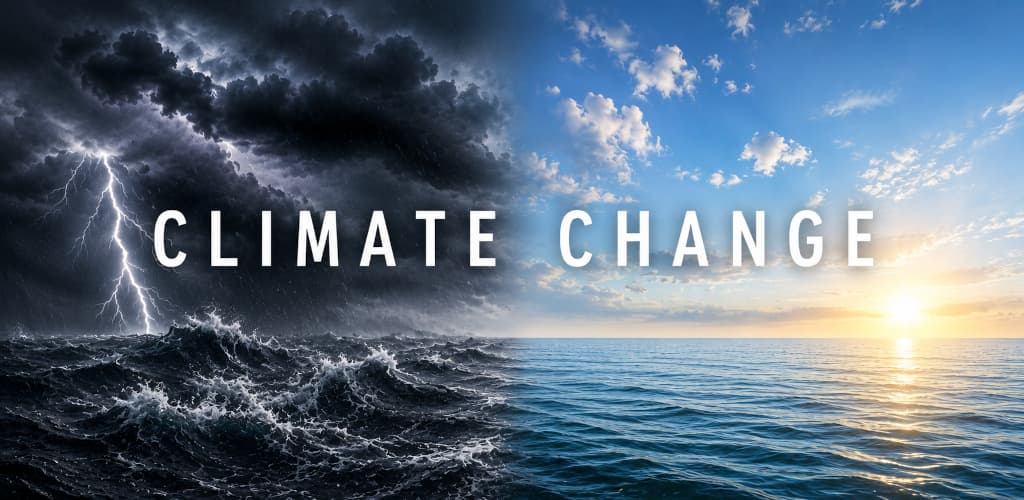
Part of the challenge is that the term “global warming” does not fully describe what is happening. It sounds as if every place on Earth is simply getting warmer, but the climate is changing in more complex ways.
The planet has warmed by just over one degree Celsius since the pre-industrial era. While that may not sound like much, it is enough to alter weather patterns around the world.
Instead of just higher temperatures, we are seeing more extreme and less predictable weather. According to the IPCC, a larger share of tropical cyclones now reaches Category 3 or higher, while wildfire seasons in some regions last more than a month longer than they did 35 years ago.
What Are We Doing About It?
The good news is that countries, companies, and scientists are already working on ways to slow climate change and reduce its impact. There isn’t a single solution, so the approach combines several different strategies:
- Switching to cleaner energy such as solar, wind, and hydro power
- Using energy more efficiently in homes, transport, and industry
- Protecting forests and restoring natural ecosystems, which absorb carbon dioxide
- Reducing emissions from factories and other industries
- Building infrastructure that can better withstand floods, heatwaves, and other extreme weather
- Creating climate policies that encourage lower carbon emissions
- Working together through international agreements to coordinate global action
Final Thoughts
Is this enough? No, not yet — at least for now. That’s why we once again decided to highlight climate change — and the fact that there is a point in discussing different opinions, not because it is pleasant, but because without it, strong solutions do not emerge.